

Differences Between Waldorf, Montessori, and Reggio Emilia Pedagogies
Some families visiting our school often ask about the differences between Waldorf, Montessori, and Reggio Emilia pedagogies. These educational philosophies have had a global impact and are applied across multiple stages, from early childhood to higher education, which is also evolving with movements such as Rosan Bosch, Invisible Pedagogies, and Art Thinking.
Historical Context of Each Pedagogy
Montessori Method
The Montessori Method originated in Italy at the end of the 19th and the beginning of the 20th century. It was developed by Dr. Maria Montessori, who created an approach grounded in the scientific observation of children’s learning.
Waldorf Pedagogy
Waldorf education began in 1919 in Germany, following World War I. It was initiated by the owner of the Waldorf-Astoria cigarette factory, who asked philosopher Rudolf Steiner to create a school for the children of his employees.
Reggio Emilia Pedagogy
Reggio Emilia pedagogy emerged after World War II, when families in the town of Reggio Emilia, in northern Italy, promoted the creation of municipal schools. Loris Malaguzzi later consolidated its principles around 1970, notably through the philosophy of the Hundred Languages of Children.


Core Principles of Each Pedagogy
Montessori Method: Learning Through Self-Exploration
- Considered a “scientific method” based on the clinical observation of human development.
- Operates in a prepared environment guided by the educator, where the child is the protagonist, choosing what to learn according to their interests within the opportunities provided.The environment is adapted to each developmental stage and age group.
- The academic curriculum is structured from infancy through university preparation, covering Practical Life, Sensorial, Mathematics, Language, and Culture.
- Individual pacing is respected, fostering autonomy and critical thinking.
- Emphasizes individual learning.
- Specialized materials support sensory exploration, self-correction, and learning from concrete manipulation toward abstract concepts—learning is hands-on.
Waldorf Pedagogy: Spiritual and Artistic Development
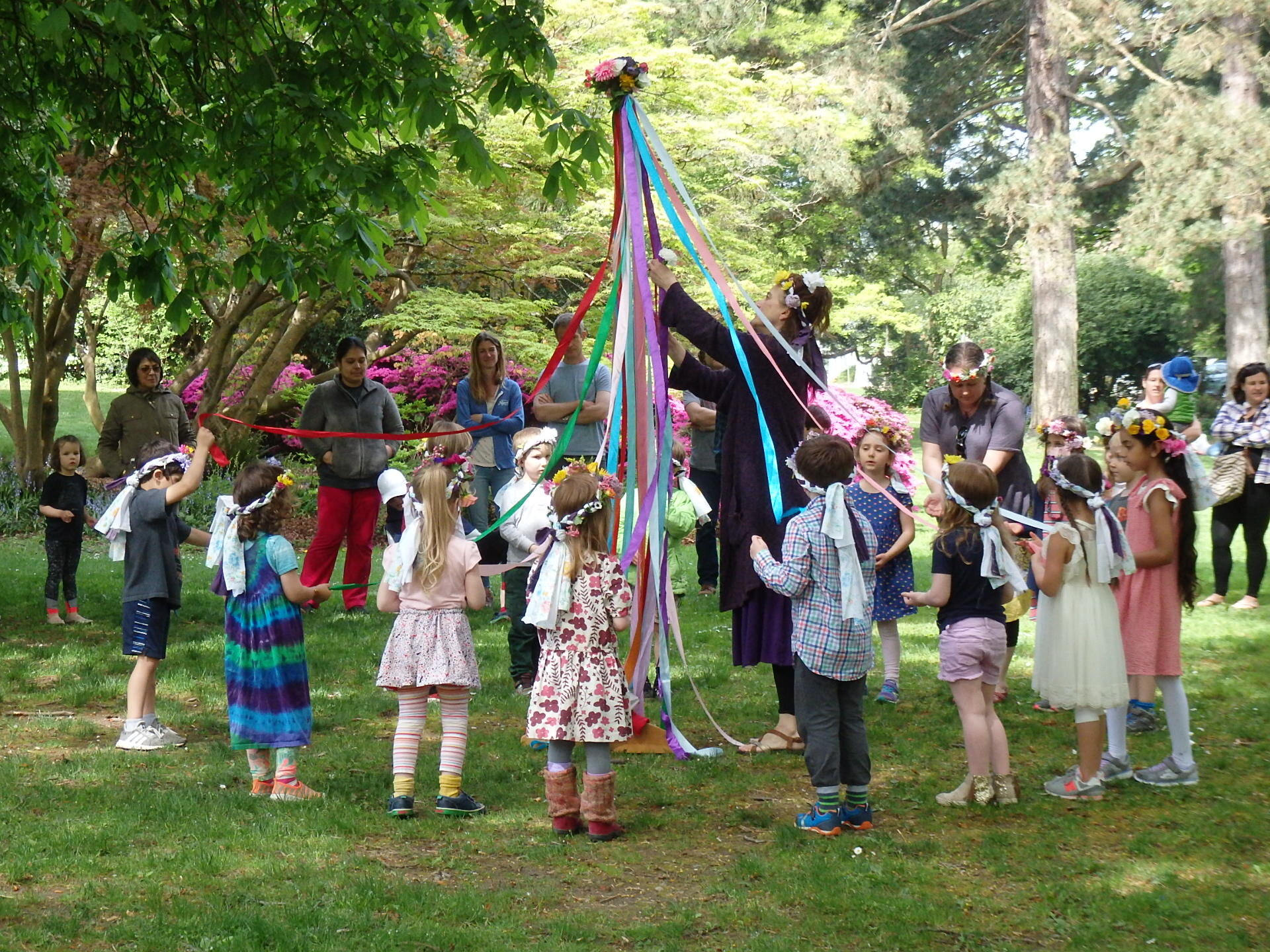
- Based on anthroposophy, emphasizing the self-education of teachers as inspiring figures. Spiritual foundations are reflected in games, songs, and rituals.
- Teachers are seen as authorities not through imposition, but through admiration from students.
- Focuses on holistic human development: thinking (cognition), feeling (emotions), and doing (practical skills).
- Education is organized in seven-year cycles: 0–7 years, 7–14/18 years, each with a specific focus.
- Ages 0–7: Free movement, unstructured play for creativity (loose parts, marbles, dolls without faces, handmade toys), artistic development (drawing, modeling, weaving, singing, dancing, storytelling), and household tasks. Indoor spaces mimic a miniature home and are combined with time in nature.
- Ages 7–14/18: Academic learning introduced through movement, imagination (mythology, gnomes, fairies), and art, alternating conventional classrooms with workshops and outdoor areas.
- Colors and painting techniques are carefully selected for each age, applied both in materials and student artworks.
- The curriculum is predefined and includes history, geography, mathematics, sciences, languages, arts, mythology, and physical education.
Reggio Emilia Pedagogy: Inquiry-Based Learning in Creative Contexts
- Based on the Hundred Languages of Children, encouraging learning through multiple forms of expression beyond words.
- Art is central in Reggio Emilia pedagogy, used as a means to explore, communicate, and construct knowledge. Therefore, in Reggio, art is more than acquiring skills—it is about communicating, feeling, being, doing, and thinking. All of this begins from a very early age, because when did our children first start asking questions at home?
- Learning is socioconstructivist, with knowledge built in community and supported by respectful adult guidance.
- Documentation of learning through written and visual records and constant observation begins with teachers, progressively including students documenting their own learning materials.
- Everyday life, recycling, the surrounding environment (the city), and nature are key elements in the educational process. Even a shadow cast by light or watching leaves fall from the trees holds countless learning opportunities—concepts of physics, the life cycle of plants, the seasons, the rotation of the Earth, the solar system, and gravity.
- It is considered the pedagogy of listening and wonder, as it carefully observes and documents what happens through the materials and the proposals presented by the adults. At the same time, it offers these proposals in a beautiful, thoughtful, and inspiring way that sparks curiosity and awakens the drive to learn.
- Human beings need answers, but they also need the opportunity to ask questions in order to feel the impulse to seek those answers—in other words, to pursue learning.
- During early childhood, from ages 0 to 6, children draw, paint, model, sing, dance, dramatize, play with light and color, move freely, and interact with the natural environment. But this does not happen in isolated or disconnected activities; rather, all these artistic languages are integrated throughout the projects designed by the educators and teachers. At the same time, children begin to discover the grammar underlying each of these languages, allowing them to experiment and formulate hypotheses.
- From age 6 onward, students begin preparing for the cultural and human construct of literacy. The main goal of this pedagogy is to develop autonomy, enabling students to construct their own manuals and learning through fieldwork and research.
- Teachers and educators investigate daily to provide their groups with a variety of proposals and topics to explore. Students become amazed, engaged, and connected—they want to know more. This sparks questions, and the entire learning community works together to provide answers. From this perspective, all curricular areas (mathematics, languages, nature, culture and society, physics, chemistry, arts) are approached holistically, coherently, and in connection with life.
- Through this approach, grounded in wonder and motivation, diverse resources and materials are employed. Especially significant is the use of everyday or discarded materials, which gain dignity within the school environment.
- Transdisciplinary learning, guided by the students themselves with the support of teachers, enables the brain to form neural connections across different areas, establishing links between learned knowledge and creating meaningful, lasting learning that can be applied in any area of life or education. This learning can progressively expand according to each child’s individual pace.
- Curricular programming is not entirely predetermined, as it is impossible to anticipate which questions will arise or to what extent they will spark interest. This requires deconstructing the known and reflecting on how we truly learn. It requires trusting the reality we witness and allowing ourselves to be drawn in by wonder and the fascination of the uncertainty inherent to childhood and adolescence—to life itself. Adults are sometimes blind to the details and may not notice what students are communicating, which is often of great value in guiding educational practice.
In this way, by approaching any field of study through the “Hundred Languages”, learning occurs in one way or another. But if there is only one way to communicate and learn—remember, not everyone learns the same way—many opportunities are lost along the way.
Do you know that person who always seems to have a solution for everything and, instead of getting overwhelmed, finds a way forward? That is the gift that Reggio pedagogy offers to the future of our children. A living, contemporary pedagogy that, building on the active education approaches of the early 20th century, connects deeply with children and with today’s society.

Similarities Between Montessori, Waldorf, and Reggio Emilia
Despite their differences, Montessori, Waldorf, and Reggio Emilia share several core principles:
- Respect for each child’s natural rhythms and the view of childhood as a stage of competence and active learning.
- Valuing everyday life, nature, culture, and society, so that schools include practical life activities aimed at fostering true autonomy and freedom.
- Limiting excessive use of technology and screens in the classroom, allowing their use only for specific purposes and under supervision.
- Use of natural and recycled materials, moving away from conventional and overly commercialized or sexualized toys.
- Importance of art as a tool for learning and expression (especially emphasized in Waldorf and Reggio Emilia).
- The learning environment as an educator, designing spaces that support and enhance learning.
- Encouragement of free movement from early childhood, inspired by Pikler pedagogy, for holistic personal development.
- Equal emphasis on physical, intellectual, and emotional development.
- Experiences of play, movement, experimentation, and natural drawing in ages 0–6, which help develop the skills needed for later literacy. A child who is seated doing worksheets from ages 2–3 is not developing these skills appropriately, which can be highly detrimental to their physical, cognitive, and emotional development.
- Students create their own study manuals, fostering autonomy and ownership of learning.


Conclusion
Each of these pedagogies offers a unique approach to early childhood and school education, yet they all share a respectful, creative, and child-centered vision of learning. For some families, it may be difficult to accept that learning is not entirely pre-structured. However, trusting in the natural curiosity of children and their capacity for wonder allows for the development of deeper, more meaningful, and lasting learning experiences.